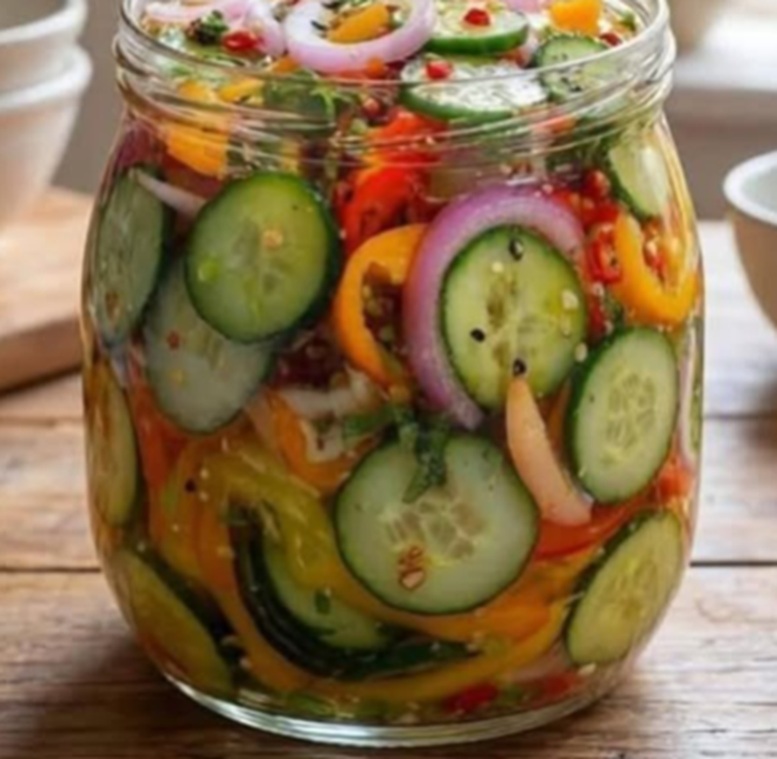
Need healthy travel snacks Pickled Cucumber, Onion & Bell Pepper Salad !! is light refreshing and perfect for road trips Explore
Every summer, when my grandmother’s garden erupted with more cucumbers than any family could eat in a week, she’d do what generations before her had done — she’d pickle them. Not with a canning kit or a thermometer. She’d salt them in a colander over the sink, whisk together vinegar, sugar, and pepper “until it smells right,” and by dinner time the kitchen would smell like a delicatessen. That Pickled Cucumber, Onion & Bell Pepper Salad sat in the center of the table alongside grilled chicken and crusty bread, and every single person reached for it first.
This guide is for everyone who’s tried a pickled cucumber recipe and ended up with a soggy, watery disappointment. We’re going to fix that — permanently. You’ll learn the science behind the crunch, the vinegar that suits your palate, and global flavor variations that can turn this humble homemade pickles salad into a signature dish.
“The best pickled cucumber salad isn’t just a recipe — it’s a technique. Master two simple steps and you’ll never make a mushy salad again.”
Ingredients
2 large English cucumbers, thinly sliced (2–3mm)
1 cup tri-color bell peppers, julienned or thinly sliced
½ medium red onion, thinly sliced into half-moons
1 tsp pickling salt (for draining cucumbers)
¾ cup white vinegar or apple cider vinegar
3 tbsp granulated sugar, honey, or maple syrup
½ tsp freshly cracked black pepper
½ tsp garlic powder (optional)
Fresh dill or flat-leaf parsley to garnish
Instructions
Toss sliced cucumbers with 1 tsp pickling salt in a colander. Set over the sink and let drain for 30 minutes. Rinse briefly and pat completely dry with a clean towel.
While cucumbers drain, slice peppers and onion. Combine in a large mixing bowl.
Whisk together vinegar, sugar (or sweetener of choice), black pepper, and garlic powder until sugar is fully dissolved. This is your cold brine.
Add the dried cucumbers to the bowl with peppers and onion. Pour brine over the top and toss well to coat every slice.
Cover tightly and refrigerate for at least 2 hours, ideally 4–6. Toss once or twice during this time.
Serve with a slotted spoon to drain excess brine. Garnish with fresh dill or parsley. Keeps up to 5 days refrigerated.
Step-by-Step Methodology
Mechanical Prep — Uniform Thinness is Everything
Use a mandoline slicer set to 2–3mm for perfectly uniform rounds that pickle evenly and present beautifully. If using a knife, hold your cucumber steady and aim for slices no thicker than a coin. Uniform thickness isn’t just aesthetic — it ensures consistent pickling and crunch throughout the salad.
The Maceration Process — Why 2–6 Hours Makes All the Difference
Cover the bowl and refrigerate. Two hours is the absolute minimum for the brine to penetrate the cucumber flesh and for the onion’s sharpness to mellow. Six hours is ideal — the flavors marry, the peppers soften slightly while retaining their snap, and the brine turns a gorgeous pale pink from the red onion. Overnight? Even better.
Natural Sweetener Options
Standard white sugar gives a clean sweetness, but if you’re following a Paleo or low-glycemic diet, honey adds floral complexity (use 2 tbsp per ¾ cup vinegar), while maple syrup brings a subtle woodsy depth that pairs especially well with apple cider vinegar. For a completely sugar-free version, a few drops of liquid monk fruit sweetener work surprisingly well.
Questions People Actually Ask
Can I freeze cucumber salad?
Hard no, unfortunately. Cucumbers are about 95% water, and when that water freezes it forms ice crystals that basically destroy the cell walls. What comes out of the freezer is a mushy, waterlogged mess — not the crunchy salad you put in. Stick to the fridge, eat it within 3–5 days for the fresh version (or up to 2 months if you went heavy on the vinegar).
Do I need to peel English cucumbers for this recipe?
Nope, and honestly please don’t! English cucumber skins are thin, totally edible, and way more tender than regular garden cucumber skins (which can be tough and a little bitter). The skin also has fiber, vitamin K, and silica in it, plus it gives you those pretty green edges that make the salad look so good. Just give the cucumber a rinse and you’re good to go.
What is the best salt for pickling?
Use pickling salt (sometimes called canning salt) — it’s just pure salt with no additives. Regular iodized table salt has iodine and anti-caking agents that can make your brine turn cloudy and sometimes leave a faintly bitter taste. Pickling salt keeps everything crystal clear and clean-tasting. If you only have kosher salt, that works too — just use a little more since the larger crystals are less dense than pickling salt.
Why is my brine cloudy?
Usually it’s one of three things: you used iodized salt (see above!), there’s some natural fermentation happening from good bacteria (totally harmless, especially common when garlic’s involved), or it’s just a little vegetable starch. All of those are normal and fine. If the cloudiness shows up suddenly after several days AND it smells off — that’s when you should throw it out and start fresh.
Can I make this recipe sugar-free?
Yep, totally! The sugar’s really just there to balance the sharpness of the vinegar — it’s not doing anything for preservation. You can skip it entirely for a more classic, deli-style sour pickle, or swap in monk fruit sweetener, erythritol, or stevia. The texture and how long it lasts in the fridge won’t really change at all.